
Designing with Intelligence: A Bioindividual Framework for AI in FemTech
FemTech has spent the last decade building apps that track, remind, and surface data. But data without intelligence is just noise. And intelligence without nuance is dangerous.
As AI moves from novelty to infrastructure, the next wave of FemTech won’t be defined by who uses AI fastest - but by who uses it most responsibly and precisely. That begins with one core principle:
Bioindividuality is the heart of FemTech design.
In women’s health, no two bodies are alike - and even the same body changes dramatically across life stages, stress levels, hormonal cycles, metabolic states, and age. AI can help us decode this complexity. But only if we stop designing for engagement and start designing for clarity, trust, and emotional agency.
Here’s a framework for how AI can meet the moment.
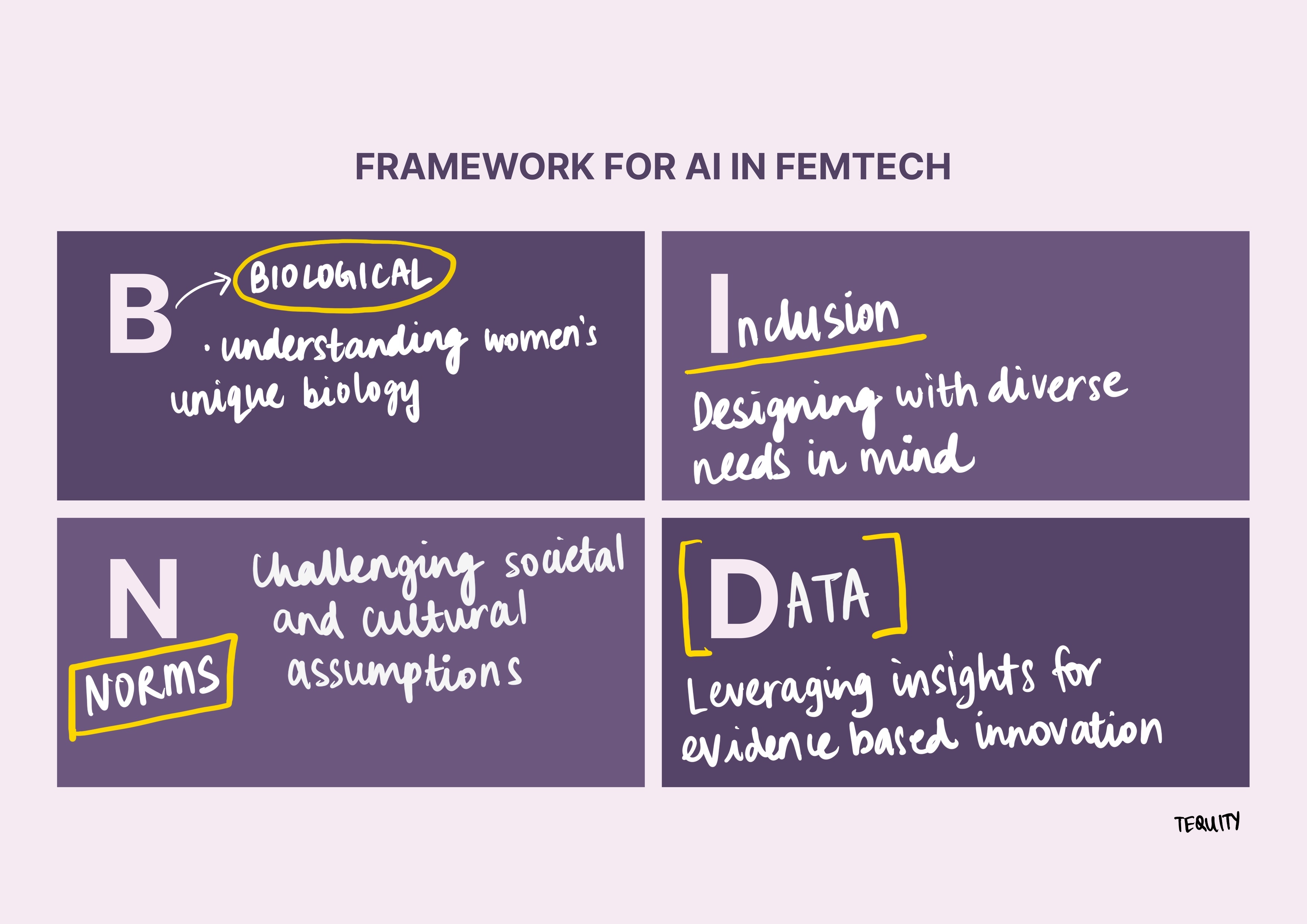
The BIND Framework: Designing AI for Bioindividual Needs
BIND is a four-part framework for integrating AI into FemTech products with intelligence that respects the body it serves.
1. Bioadaptive Learning
AI must move beyond static personas. Hormonal patterns, mental health triggers, metabolic responses, and genetics vary not just between users, but within the same user over time.
- Design for fluctuation instead of consistency.
- Use AI to detect individual patterns across time, instead of averages across populations.
- Example: Instead of alerting a user to an "irregular period," train the system to understand what “irregular” means for her body.
2. Intentional Data Use
Too many products still train AI models on male-default datasets or non-diverse samples. Worse, many over collect sensitive data with vague benefits.
- Design data models around real use cases, not what’s easy to collect.
- Be transparent about what data is used and why.
- Example: For mood tracking, integrate qualitative language inputs with privacy-first sentiment analysis rather than pushing numerical ratings.
3. Nuanced Personalization
AI-driven personalization often means surface-level suggestions. Real personalization in FemTech must reflect physiological, psychological, and contextual nuance.
- Tailor insights to life stage: adolescence, fertility, postpartum, perimenopause, etc.
- Let users set their own definitions of success: hormonal balance, emotional regulation, fertility readiness.
- Example: A PCOS user and a menopause user may both log fatigue - but the cause, context, and care pathways differ.
4. Design for Agency
AI shouldn’t replace the user’s intuition - it should deepen it. Design for self-efficacy, rather than dependency.
- Let users interrogate how insights were generated.
- Give options, instead of one-size fits all prescriptions.
- Example: Instead of saying "You are likely ovulating," offer, "Your recent patterns suggest ovulation may be occurring. Here's why."
For Founders: Building Bio-Intelligent Products
Ask yourself:
- Does our AI model learn with the user, or just from other users?
- Are we personalizing insights or just tailoring notifications?
- Are we building for long-term trust, or short-term engagement?
FemTech deserves more than pink-washed dashboards and predictive pings. It demands tools that honor complexity, deepen bodily trust, and evolve with the user.
For Investors: The Future Isn’t Just AI. It’s AIBI.
Artificial Intelligence + Bioindividual Insight = AIBI
Back founders who are building with users' bodies, not just on their data. Look for teams prioritizing physiological modeling, hormone-aware design, and truly diverse datasets.
The winners in this space won’t be those who "do AI" – they’ll be those who do biointelligent AI.