
What Most FemTech Products Get Wrong About Product-Market Fit
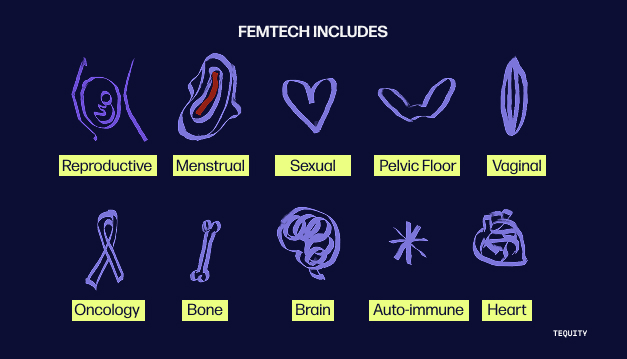
FemTech is now a 60 billion dollar market. Investment is flowing, founder energy is high, and product launches are accelerating. But much of the design logic still mirrors generic healthtech or wellness tools. The assumption is that a cycle tracker or symptom logger should work the same way a fitness app does. Engagement equals success, retention equals validation.
This creates a misalignment between what’s built and what women actually need.
Conditions like endometriosis, PCOS, perimenopause, and postpartum depression are not solved through daily nudges, friendly colors, or habit loops. These are long, complex, emotionally charged experiences where value looks very different: relief, clarity, and trust. In other words, not engagement, but something deeper.
At Tequity, we approach FemTech as systems design. Our goal is to create products that align with how care is actually experienced. That often means starting where traditional UX ends.
Most Products Assume Linear Behavior
The dominant mental model in consumer health design assumes the user has a clear goal, predictable behavior, and control over their outcomes. The job of the product is to create motivation, ease of use, and tight feedback loops. That works for tracking water intake or running mileage. It breaks down when applied to hormone cycles, diagnostic delays, or chronic fatigue.
In FemTech, user journeys are rarely linear. There is no stable baseline, no standard routine. Hormonal patterns, mental health triggers, metabolic responses, and genetics vary widely, not just across women, but within the same individual over time.
Designing for this kind of variability means building systems that can absorb fluctuation without breaking the user experience. That’s a harder problem, but also where the opportunity lies.
FemTech Is a Systems Problem, Not a UX Problem
Women managing health issues like PCOS or fertility challenges often interact with more than just your app. They’re also dealing with doctors, blood work, insurance rejections, cultural stigma, Reddit threads, and a constant sense of uncertainty. Product design in FemTech needs to acknowledge that it is one piece of a larger, often fragmented system.
We start with research: in-depth interviews that reveal how people manage time, energy, symptoms, and trust across these systems. From this we’ve identified three constants:
- Journeys are nonlinear and often interrupted
- Biological and emotional inputs shift weekly, even daily
- Users define success through clarity and relief, not just progress
This leads to a different definition of product-market fit.
A Bioindividual Definition of Success
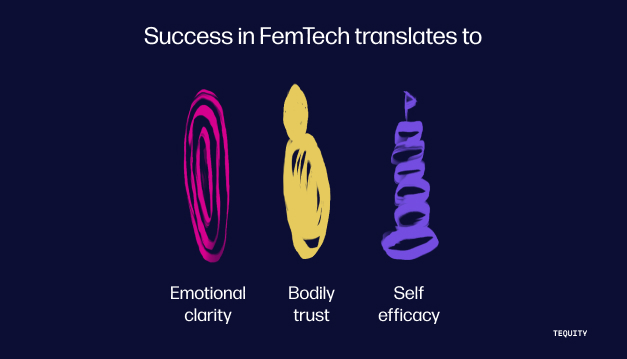
In FemTech, success is not engagement. It is emotional clarity, bodily trust, and self-efficacy.
A woman who logs symptoms once a week but finally understands what’s going on with her cycle is a success story. A user who feels confident bringing app data into a doctor’s office is finding value. The point isn’t time spent in-app, it’s life made slightly easier outside of it.
We track that through co-defined outcomes:
- Less anxiety during menstruation
- Greater confidence in fertility planning
- Better communication with care providers
- Earlier recognition of symptoms that lead to a diagnosis
These outcomes often look small from the surface, but they reflect meaningful shifts. They are also where long-term product affinity is built.
Designing for Complexity, Not Frequency
Daily active users are a tempting metric, but they aren’t always relevant in FemTech. Many users don’t want to be in the app every day. Some are managing grief, medical trauma, or decision fatigue. Our work focuses on creating systems that support people when they need help, not systems that depend on constant use.
That means:
- Using visual timelines to show how scattered data adds up
- Sending milestone messages that reflect real progress, like consistent logging over three months
- Offering quick emotional feedback when someone tracks symptoms, even if the data is incomplete
- Automating repetitive tasks so that the product reduces mental load
These tools act as behavioral scaffolding. They give people reasons to stay engaged across long, unpredictable timelines.
Most PMF Metrics Miss the Point
Traditional PMF is measured by things like user growth, conversion, retention, and session time. These numbers do matter. But in FemTech, they can mislead. A product can have high retention and still fail to make users feel seen, informed, or safe.
The deeper signals of PMF often live elsewhere:
- Do users trust the information?
- Do they come back when something changes in their health?
- Do they recommend it in private communities?
- Does it help them feel less alone in their experience?
FemTech products are often judged by what is visible: DAUs, feedback scores, growth. But their value lies in what is harder to quantify - shifts in emotion, clarity, and confidence.
Designing for Trust and Regulation at the Same Time
Many FemTech products are touching diagnostic territory or regulated data. That makes trust both a design issue and a compliance issue. The safest approach is to build both into the product from day one.
That includes:
- Bringing in legal and regulatory advisors early
- Writing consent in clear, human language
- Planning for HIPAA, GDPR, and evolving reproductive privacy laws
- Offering discreet modes for use in unsafe environments
- Including opt-outs for sensitive periods, like grief or mental health episodes
This is a trust architecture, not just bells and whistles. It signals to the user: this product understands your reality.
Bias in AI, Language, and Logic
As FemTech tools begin to use AI for symptom analysis or personalization, bias becomes a structural risk. We audit data sources to ensure representation. We include “inconclusive” as a valid output when needed. We add human oversight where automation isn’t enough.
Language matters here too. We remove shame-based copy, especially in areas like weight, mood, and reproductive loss. We offer content in multiple formats to reflect different cognitive and emotional needs.
The goal is not just accuracy, but emotional fluency.
What We’re Building Next
Tequity is approaching and working across a few emerging edges in FemTech. These include:
- Menopause and longevity platforms with smarter personalization and clearer UX
- Localized fertility tools for India, MENA, UK and America
- Wearable-linked hormone and metabolic tracking
- Mental health tools that account for hormonal fluctuation
- Decentralized health data models that give users more control and choice
Each of these spaces combines technical complexity, emotional depth, and cultural nuance. We believe good design holds all three together. It does not flatten them into features. It makes them legible, usable, and valuable.